
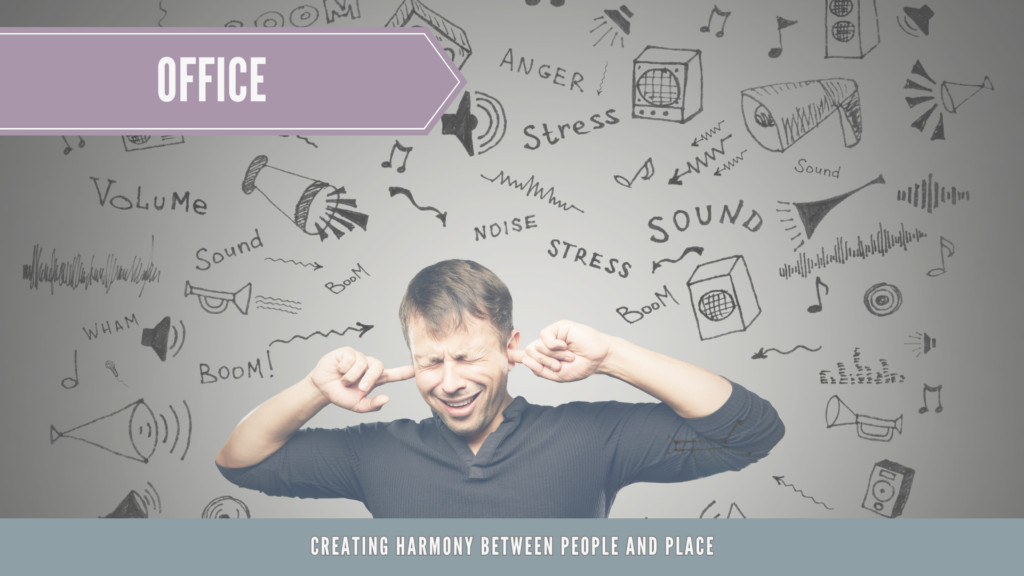

Open plan offices lead to collaboration, and distractibility problems in particular. But on the other hand, noise has become an unavoidable companion in today’s dynamic and increasingly open workplaces. The irrelevant sound effect, is basically the term for how background noise, especially human speech, messes up cognitive tasks. This is one major thing that affects workplace productivity.
Psychological and cognitive science research suggests that innocuous sounds distort our thought processes, reducing the accuracy and efficiency of tasks such as reading, problem solving or complex calculations, especially when we need to focus, as in the case of.
The irrelevant sound effect or ISE is that kind of sounds which interfere with a person’s working memory, or the cognitive system that temporarily holds and processes information.
While people need to concentrate on tasks, because they’re easy to interrupt, their working memory is also vulnerable. Passing a constant background conversation makes this effect especially obvious, since our brains are designed to extract speech out of noise, in a way that is more resistant to being ignored or tuned out than background music or white noise, for instance.
Tasks that require simultaneous processing and storage of information, rely on working memory. Those tasks can be eading with comprehension, logical thinking, etc. Background conversations interfere with their noise. It is pulling cognitive resources away from the task the mind is focused on and requiring it to increase its effort to filter out extraneous stimuli. The result? Mental fatigue, errors and simply reduced productivity.
Open plan spaces are rarely cordoned off, resulting in a lot of ambient sounds, such as typing, footsteps and, most importantly, conversations. While these sounds are trivial, they can have a huge negative impact on cognitive performance.
Studies show that in workplaces where people’s conversations are easily audible, employees experience more interruptions. It is especially when the topics of conversation are not relevant to the work they are supposed to be doing. These conversations seem even harder to ignore because they’re irrelevant. The structure of our brain is wired to pick out and understand speech patterns. Particularly when the words or subjects covered can be so easily identified. When employees focus, the working memory system is trying to work out what the background chatter is. That happens even though it’s irrelevant to their current work, and it pays more attention than it ought to.
The irrelevant sound effect has direct consequences for tasks that rely heavily on cognitive control.
In a work environment, this effect manifests in several ways:
- Difficulty in reading comprehension. Traffic noise impacts reading comprehension extremely easily because reading is a process of new information processing and knowledge integration. Short exposure to irrelevant speech can decrease comprehension and increase text processing time, suggests these studies.
- For example, error rates in a test of problem solving and calculations, are also heavily dependent on working memory resources. Background conversations will result in higher error rates and less efficiency due to the fact that the mind has to shift between that which is task related and filtering out noises.
- Constant background chatter becomes the enemy. It requires increasing effort from employees to ignore distractions and leads to decreased focus and mental fatigue. This results over time to cognitive fatigue is that it becomes even harder to concentrate on work and even lower the overall productivity of an employee.
- It also affects impaired decision-making and creativity, my definition of cognitive tasks that require deep thinking, but also deep creativity. If you are busy blocking out background noise, you are less able to think abstractly. And less able to make decisions and come up with creative solutions.
How to minimize the irrelevant sound effect in the workplace?
Oorganizations can adopt several strategies to help employees maintain focus and optimize productivity:
- Devices with white noise or soft background music can mask distracting sounds and minimize the impact of background conversations. Opening up a space can also be made less noisy with acoustic panels, sound absorbing materials and spatial dividers.
- For employees who need quiet, this might be designated quiet zones, or have access to private work spaces. However, these spaces can also be mental sanctuaries where people can work on complex tasks.
- A lot of companies permit noise canceling headphones or instrumental music at low volume to work. All this will help cut down on background noise and set a listening experience with this just for you that it goes to help block out distractions in focus.
There are many benefits of open-plan offices. But the irrelevant sound effect adds a reason to think about acoustic consequences on cognitive performance. If this effect is acknowledged and addressed, workplaces can set up an atmosphere which is conducive to a healthy combination between collaborative work and concentration. If background noise is managed well, employees will, on the whole, be better at focusing, minimize mistakes and be happier at work which leads to a happier and more productive work atmosphere.